Hiking Mount Whitney in One Day: Our First 14,000-Foot Summit
We were honestly pretty surprised when we got Mount Whitney permits this year, especially after already getting Half Dome permits earlier in the year. Mount Whitney had been on our list for a long time, but this one made us a little more nervous than some of the other big hikes we have done. So we were excited to do the Mount Whitney hike.
The distance wasn’t really what worried us. We have a lot of 20+ mile hiking days under our belt. The biggest question for us was the elevation.
Mount Whitney sits at 14,505 feet and is the tallest mountain in the lower 48 states. This was going to be our first time standing above 14,000 feet, so we really didn’t know how our bodies were going to react once we got that high.
Getting to Mount Whitney
Mount Whitney is located in California’s Sierra Nevada mountains near the town of Lone Pine. Lone Pine is probably the easiest place to base yourself before the hike. There are restaurants, grocery stores, gas stations, hotels, and pretty much anything else you might need before heading up.
The Mount Whitney Trail starts at Whitney Portal, which sits around 8,300 feet above sea level.
We decided to camp at Whitney Portal the night before our hike. Our thought was that spending the night already above 8,000 feet would at least give our bodies a little time to adjust before climbing another 6,000 feet the next day.
Whitney Portal also has a small store and restaurant right near the trailhead.
And that store saved us.
We somehow made it all the way to Mount Whitney before realizing we forgot our headlamps. Since we planned on starting in the dark, that was kind of an important thing to have. Thankfully, the store at Whitney Portal had headlamps and we were able to grab some before starting the hike.
Mount Whitney Permits
You need a permit to hike Mount Whitney during the permit season.
There are two main ways people do it.
You can get an overnight permit and backpack the trail, or you can get a day-use permit and hike Mount Whitney in one day.
We got day-use permits.
The standard Mount Whitney Trail is roughly 22 miles round trip with around 6,000 feet of elevation gain. It is a long day, but because we already had experience hiking similar distances, we felt pretty confident about doing it without camping.
If 20+ miles at elevation sounds like too much, backpacking is definitely another option.
A lot of people camp at Trail Camp, which sits around 12,000 feet before the famous switchbacks. One thing we noticed, though, is that Trail Camp gets extremely busy. There are only so many good places to set up a tent, so I would still recommend getting an early start even if you are backpacking.
Starting the Mount Whitney Trail
One thing we immediately noticed about the Mount Whitney Trail is how well maintained it is.
For such a big mountain, the actual trail is pretty straightforward. There are signs, established switchbacks, and usually plenty of other hikers around. We never really felt worried about accidentally getting off trail.
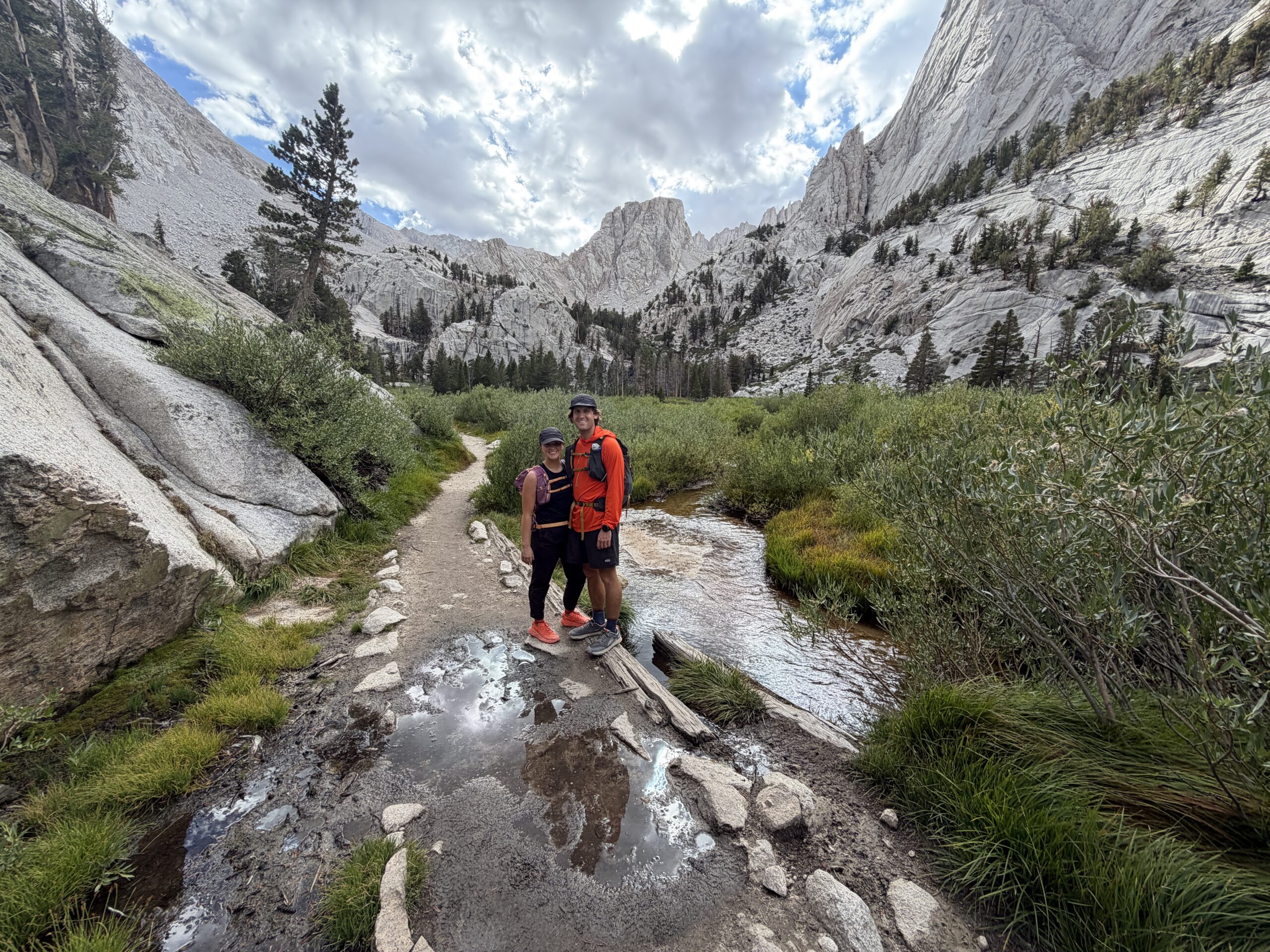
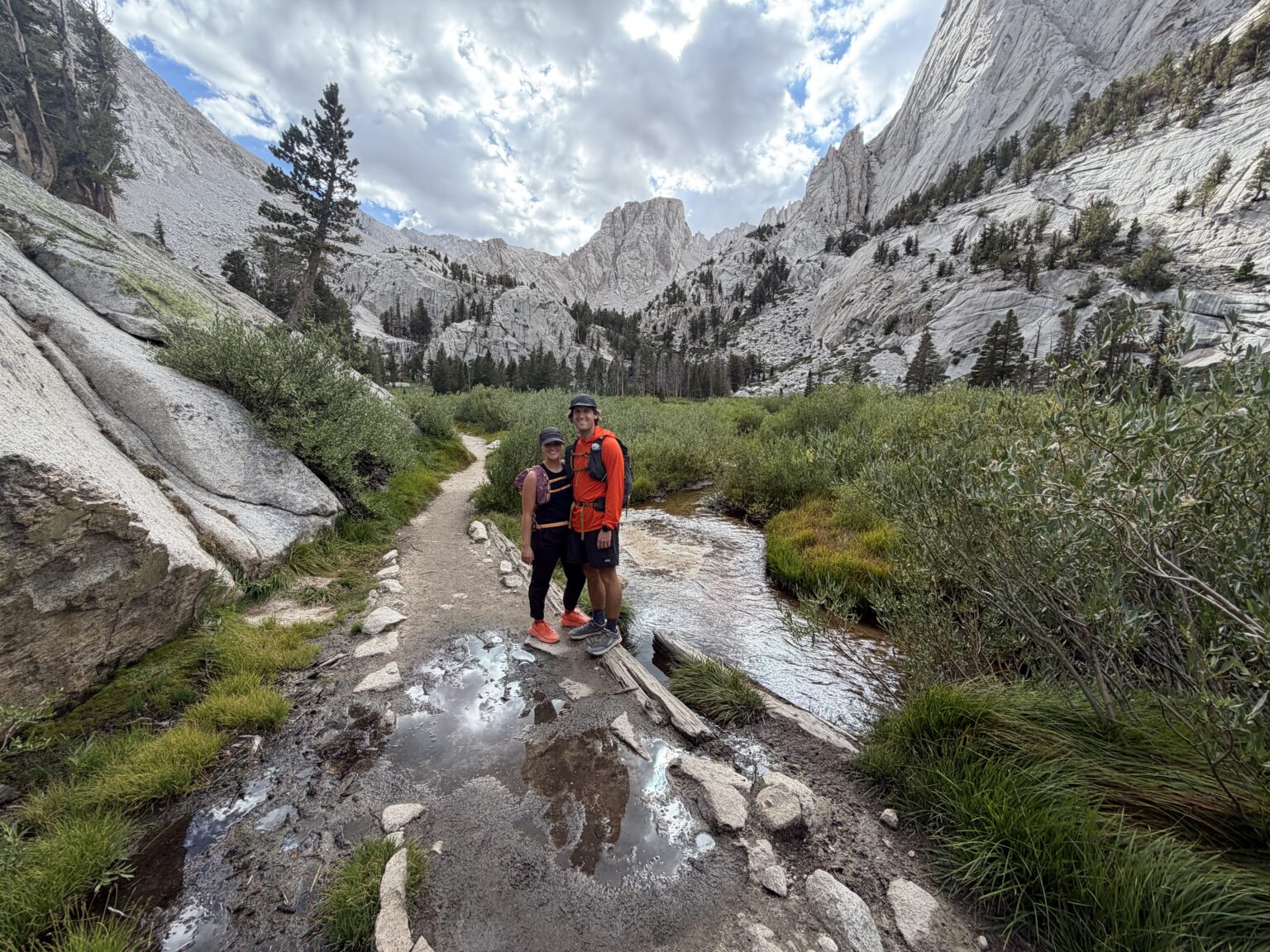
The first few miles climb steadily away from Whitney Portal through pine trees and granite mountains.
This section felt really good.
You are gaining elevation, but it doesn’t immediately feel like you are hiking toward a 14,000-foot summit. There are streams, lakes, trees, and huge granite walls surrounding you.
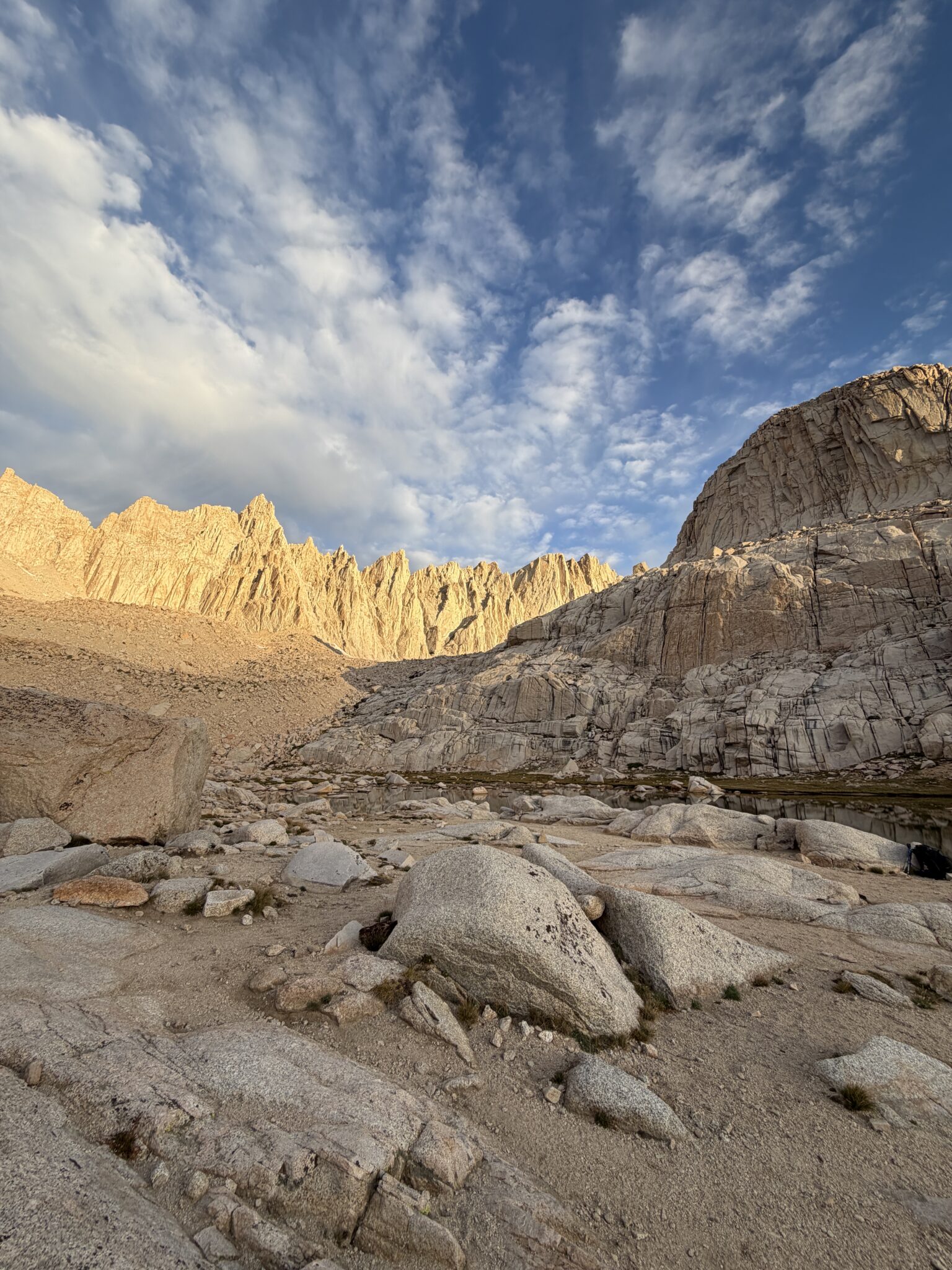
As you continue higher, the landscape slowly becomes more exposed.
The trees start disappearing, the granite becomes more dominant, and suddenly you can look back and see how far above the valley you have climbed.
Water on the Mount Whitney Trail
We brought plenty of water with us, but there are several places along the lower portions of the trail where you can filter water.
I would definitely bring a water filter instead of trying to carry every drop of water you need for 20+ miles.
Even with all of the water around, make sure you are drinking constantly.
One thing that surprised us was how hot the Mount Whitney Trail could get.
You picture hiking high in the Sierra Nevada and expect it to be freezing, but a lot of this trail is completely exposed to the sun. There are long stretches without much shade at all.
We were hot for a huge portion of the hike.
It wasn’t until we started climbing higher toward the 99 Switchbacks that the temperature really started cooling down.
Trail Camp and the 99 Switchbacks
Eventually, you reach Trail Camp.
This is one of the main stopping points on the Mount Whitney Trail and where a lot of backpackers spend the night before attempting the summit.
From here, you can look straight up at the mountains above you and see where the trail somehow has to climb next.
Then come the famous 99 Switchbacks.
The switchbacks climb from around 12,000 feet toward Trail Crest at more than 13,500 feet.
We had heard so much about this section before hiking Mount Whitney that we expected it to be absolutely brutal.
It is definitely a climb, but we didn’t think it was the hardest part of the hike.
The trail just keeps zigzagging back and forth up the mountain. You settle into a pace and slowly gain elevation.
This was also where we really started noticing the change in temperature and altitude.
Every few switchbacks, the views behind us got better and better. You can see the lakes thousands of feet below you and the Sierra stretching out in every direction.
Trail Crest
Reaching Trail Crest felt like a huge milestone.
At this point, you are above 13,000 feet and can look down into Sequoia National Park on the other side of the mountain.
The Mount Whitney Trail also connects with other trails back here, including routes used by backpackers and thru-hikers traveling through the Sierra Nevada.
There were hikers coming from completely different directions than us, which made this section feel like a little highway in the mountains.
From Trail Crest, you would think the hardest part is basically over.
That wasn’t how it felt for us.
The Final Two Miles to Mount Whitney
For me, the hardest part of Mount Whitney was the final push toward the summit.
You don’t have a massive amount of elevation left to gain, but you are now hiking above 13,500 feet.
Everything just feels slower.
Your legs can still move, but your breathing becomes more noticeable. There is simply less oxygen available that high up.
We found ourselves taking slower steps and breathing harder than we normally would on terrain that wasn’t technically very difficult.
There are also a few sections where the trail passes along exposed granite slopes, but nothing felt extremely sketchy or technical.
That was another thing that surprised us about Mount Whitney.
It doesn’t feel like some mountains where the final summit push suddenly turns into scrambling or climbing.
The Mount Whitney Trail basically remains a hiking trail all the way to the top.
The challenge is the distance, elevation gain, and altitude.
As we got closer to the summit, we kept thinking we had to be almost there.
Then the trail would wrap around another section of mountain.
And another.
Those last couple miles felt much longer than they looked on the map.
Reaching the Summit of Mount Whitney
Eventually, we could finally see the stone Mount Whitney summit hut.
Walking toward it was one of those moments where everything suddenly felt worth it.
We were standing at 14,505 feet on the tallest mountain in the lower 48.
For our first summit above 14,000 feet, it was pretty crazy.
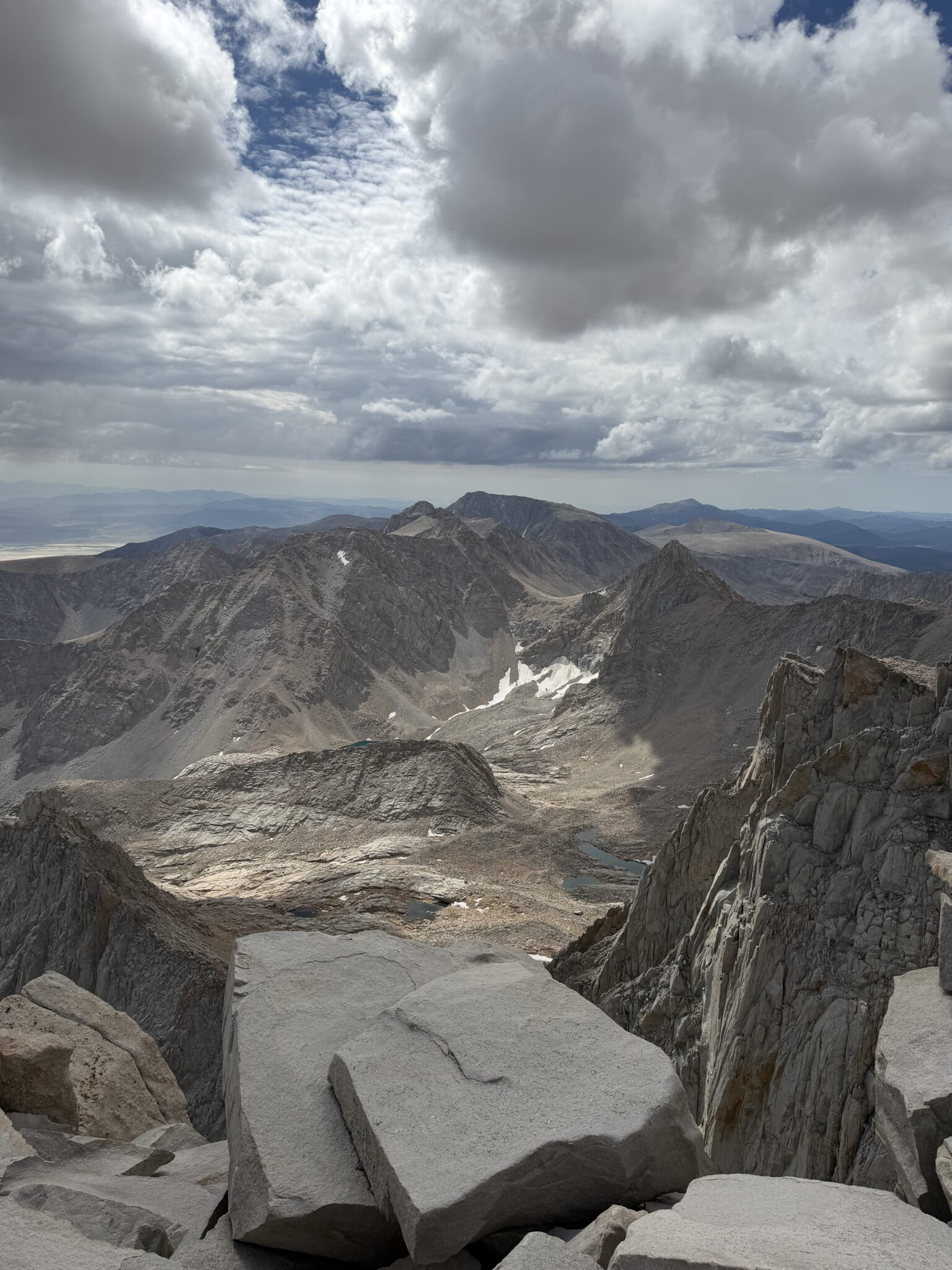
You can see mountains in every direction, with giant granite peaks and deep valleys surrounding the summit.
After worrying about how we would handle the altitude, actually making it to the top felt even better.
We spent some time on the summit taking pictures, eating, and just enjoying where we were before starting the long hike back down.
And that is another thing to remember about Mount Whitney.
Getting to the summit is only half the day.
You still have roughly 11 miles to get back to Whitney Portal.
Hiking Back Down
The return trip is obviously easier because most of it is downhill, but after that many miles, your legs definitely start feeling it.
You retrace the same route through Trail Crest, down the 99 Switchbacks, past Trail Camp, and eventually back toward the trees and Whitney Portal.
This is also why starting early is so important.
Mount Whitney is a long hiking day, especially if you want enough time to enjoy the summit without worrying about finishing in the dark.
The trail was also much busier than we expected.
There were people backpacking, day hiking, and connecting into other trails around Sequoia National Park and the Sierra Nevada.
If you are looking for a completely isolated mountain experience, this probably isn’t it.
But there is something fun about everyone on the trail having the same goal.
Camping at Whitney Portal
If you stay at Whitney Portal before your hike like we did, we have one extremely random recommendation:
Bring a mosquito net or some kind of screened shelter.
Not because of mosquitoes.
Because of the hornets.
We have never seen anything like it.
As soon as food came out at our campsite, they showed up.
And there were a lot of them.
We were making turkey sandwiches for the hike the next day and quickly discovered that apparently Whitney Portal hornets really like turkey.
Once we pulled the meat out, they completely swarmed our table and food.
We spent the rest of dinner trying to protect our sandwiches while getting attacked by hornets.
So if we camp there again, some kind of bug net is absolutely coming with us.
Is Mount Whitney Hard?
Mount Whitney is definitely hard, but probably not for the reason some people expect.
The trail itself isn’t extremely technical.
There isn’t a big scrambling section near the summit, and most of the route follows a very well established trail.
What makes Mount Whitney difficult is putting everything together.
You are hiking around 22 miles.
You are gaining roughly 6,000 feet.
And the summit is sitting more than 14,000 feet above sea level.
The final few miles especially can feel completely different depending on how your body reacts to the altitude.
If you already have experience doing long hiking days, the mileage might not be the biggest challenge. The altitude is the part you really can’t fully predict until you get there.
Would We Hike Mount Whitney Again?
Absolutely.
Mount Whitney ended up being one of our favorite big hiking experiences we have done.
It was our first 14,000-foot summit, our first time hiking this high in the Sierra Nevada, and another one of those trails that seemed almost impossible when we first started looking at it.
Then suddenly we were standing on top.
If Mount Whitney is on your list, prepare for the mileage, start early, bring plenty of food and water, carry a water filter, and don’t underestimate the elevation.
And if you’re camping at Whitney Portal…
Protect your turkey.